Quick answer
ROSCAs (rotating savings circles like Njangi, Ajo, Susu, Chama, sou-sou, paluwagan) have a near-perfect repayment record across hundreds of millions of participants worldwide. They are more reliable than many tradelines that already build credit in Canada. The reason they don't count yet is data infrastructure, not creditworthiness. Wiremi is building the bridge.
What is a ROSCA, and why are millions of people in Canada already in one?
A ROSCA, or rotating savings and credit association, is a group of trusted people who pool a fixed amount of money on a recurring schedule. Each cycle, one member receives the entire pot. The cycle continues until every member has had a turn. Then the group either disbands or starts again.
Different cultures have different names for the same structure. Cameroonians and West Africans call it Njangi or Ajo. Ghanaians call it Susu. East Africans call it Chama. The Senegalese call it Tontine. South Africans call it Stokvel. South Asians call it Committee or Kameti. Filipinos call it Paluwagan. Latin Americans call it Tanda or Cundina. East Asians call it Hui. Caribbean communities call it Partner or Sou-sou.
The estimated global participation is well over a billion people. In Canada, several million people, most of them immigrants and first-generation Canadians, are active in a ROSCA right now. They have been for generations. The Canadian credit system has not noticed.
How does a ROSCA actually work?
A simple example. Ten people commit to contributing $500 per month for ten months. Each month, one member receives the full $5,000 pot. After ten months, every member has both contributed $5,000 and received $5,000 once. Some members got a lump sum early (an interest-free advance), others late (a forced savings vehicle), and every member got both depending on which turn they drew.
The mechanic combines savings discipline, peer accountability, and access to lump-sum capital. There is no bank. There is no interest. There are no late fees. Trust is enforced socially: skipping a contribution gets you removed from the group and ends your reputation across an extended community.
This is the part traditional credit bureaus miss. The default rate inside a mature ROSCA, in cultures and countries where the practice has run for generations, is closer to zero than to one percent. Banks would kill for those numbers.
Why don't Canadian credit bureaus recognize ROSCAs?
Three reasons, none of them about creditworthiness.
First, there is no standardized reporting infrastructure. Equifax Canada and TransUnion Canada accept data feeds from regulated lenders and a handful of specialized data partners. Informal savings groups have never had a path to feed in.
Second, the data has historically been off-platform. A typical ROSCA payment is cash or e-transfer between members. There is no transaction record a bureau can verify, no central ledger, no API.
Third, the bureaus serve who they have always served: banks, credit card issuers, auto lenders, mortgage providers. The institutions that brought them the original data feeds were the institutions that immigrant communities were historically not borrowing from.
The exclusion is structural, not moral. But the result is the same: years of perfect financial discipline disappear from the credit picture.
What makes ROSCA participation a strong credit signal?
ROSCAs combine four behaviors that any credit risk model would value.
Consistency. Members commit to a fixed contribution on a fixed schedule for a fixed duration. Missing a month has immediate consequences. Long-term ROSCA participants demonstrate exactly the kind of payment reliability that credit bureaus already prize as the largest factor in a score.
Skin in the game. A ROSCA member who skips a payment burns social capital across an entire community. The cost of default is much higher than the cost of breaking a credit card minimum payment. That asymmetry produces better behavior.
Lump-sum responsibility. When a member receives the pot, they are functionally holding a short-term loan from the rest of the group, repaid through their subsequent contributions. That is exactly how lenders think about creditworthiness.
Track record at scale. A ten-month, $500-per-month ROSCA generates dozens of verifiable data points across a ten-person group, all observable on a Wiremi-style platform. That is comparable to a year of credit card activity.
Aren't ROSCAs informal? How would a bureau verify one?
This was the old argument, and it was true ten years ago. It is no longer.
When a ROSCA runs on a platform like Wiremi, every contribution is captured in escrow until payout day. Every payment is timestamped, tied to a verified member identity, and recorded on a tamper-evident ledger. The group's structure (members, contribution amount, frequency, payout order) is configured up front and immutable for the duration of the cycle. There is no informal handshake at the end of the month. There is a verifiable transaction with proof.
The same data feed that lets a bureau accept rent-reporting data from a third-party service can accept ROSCA contribution data from a platform that captures it correctly. The infrastructure exists. The willingness has not.
What would it take to bring ROSCAs into the Canadian credit system?
Three things, in order.
A data layer. A platform that captures ROSCA participation in a structured, verifiable, auditable format that maps cleanly to the data formats credit bureaus already accept. This is the technical piece. Wiremi is built on top of exactly this layer.
A bureau partnership. A direct relationship with Equifax Canada or TransUnion Canada that recognizes the data feed as a valid tradeline type. This is the regulatory and commercial piece. Wiremi is in early conversations with major Canadian credit bureaus on exactly this. The path is direct relationships, not third-party intermediaries.
Volume. Bureaus do not take new tradeline types seriously until there is a meaningful population of consumers to whom they apply. Every ROSCA hosted on a Wiremi-style platform builds toward that volume. The case strengthens with every payment.
The ten-year answer to "why doesn't a ROSCA count" was that the data didn't exist. The 2026 answer is that the data is there and the infrastructure is being built right now.
Where does Wiremi fit in?
Wiremi is doing the work to make this real.
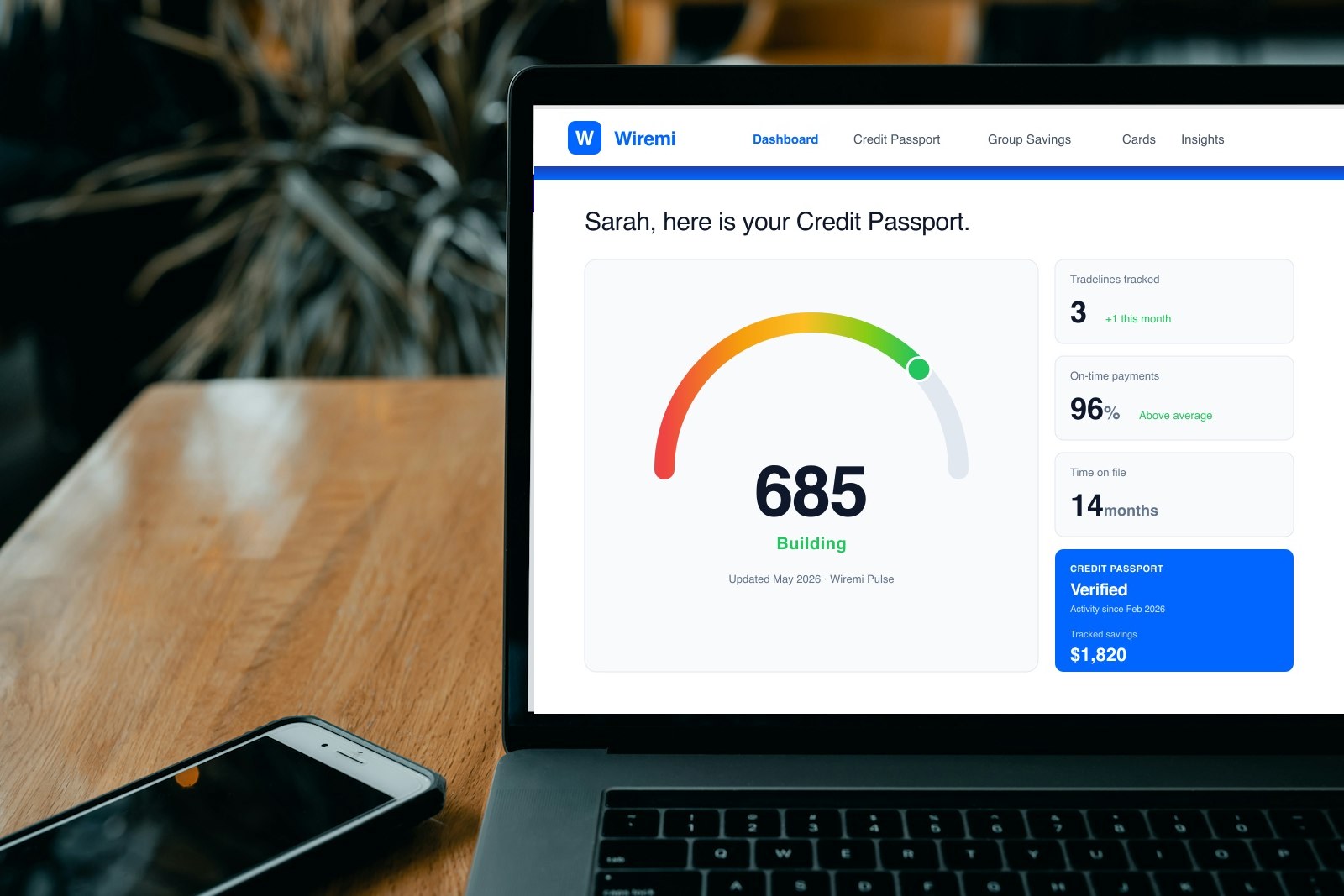
The Wiremi app runs traditional rotating savings circles digitally, with escrow protection and automated rotation across 141 countries. Every contribution is captured on the Wiremi Passport, the portable financial profile Wiremi is building for newcomers, the diaspora, and anyone with a thin credit file.
When the bureau pilot launches, your existing ROSCA history on Wiremi becomes part of your reported Canadian credit record. Until then, the Wiremi Passport is a verifiable, shareable record some landlords and lenders already accept as alternative credit data.
This is the category Wiremi is defining. Not faster remittance. Not another wallet. Portable financial identity that recognizes what immigrants and diaspora communities already do well.
What you can do today
If you are already in a ROSCA, run it through Wiremi. Every contribution builds a verifiable record of financial discipline on your Wiremi Passport. When the bureau pilot launches, that record becomes credit history.
If you have not joined one, the Group Savings feature inside the Wiremi app lets you start or join a circle with people you trust, across 141 countries, with escrow protection.
If you work at a bank, a bureau, or a regulator and you read this far: the data is ready. The willingness is the missing piece. Get in touch at [email protected].