Wiremi Verify · Developers
One endpoint, one webhook.
Request a check, get a signed event when the subject answers, then pull the file. Sandbox keys are free and unlimited. Live accounts get twenty free soft checks a month.
- Base URL
- api.verify.wiremi.ca
- Version
- v1
- Auth
- Bearer key
POST /v1/checks
Authorization: Bearer wv_live_••••
Idempotency-Key: 7c1d…

{
  "credit_id": "CC-9K10-3B85",
  "depth": "soft",
  "purpose": "lending_decision",
  "requester_region": "US-TX"
}201 Created
{
"id": "chk_8Fk2",
"object": "check",
"status": "awaiting_consent",
"depth": "soft",
"purpose": "lending_decision",
"expires_at": "2026-08-22T10:19:04Z"
}Quickstart
Your first check, in your language.
Point the same call at the sandbox host with a sandbox key and it returns fixture files without waiting for a person. Swap the host and the key to go live. Nothing else changes.
curl https://api.verify.wiremi.ca/v1/checks \
  -H "Authorization: Bearer $WIREMI_KEY" \
  -H "Idempotency-Key: $(uuidgen)" \
  -H "Content-Type: application/json" \
  -d '{
    "credit_id": "CC-9K10-3B85",
    "depth": "soft",
    "purpose": "lending_decision",
    "requester_region": "CA-ON"
  }'
The flow
Three calls, and a wait for a human.
The wait is the product. Nothing is released until the file holder approves it in their Wiremi account, and that approval is the event you build against.
- 01
POST /v1/checks
Credit ID, depth, permitted purpose and your region. You get back a check id with status awaiting_consent.
- 02
Wait for the webhook
check.consented, check.declined or check.expired. Signed, and retried with backoff for 24 hours.
- 03
GET the report
Pull the scoped file. What comes back is exactly what the subject agreed to release, and nothing else.
- 04
Access closes
The scope expires after 30 days without you doing anything. Ask again and they approve again.
Reference
Eight endpoints. You will use three.
Request a check. Returns awaiting_consent.
Read a check and its status.
Pull the scoped file once status is ready.
Withdraw a request before the subject answers.
List your checks, filterable by status and date.
The signed consent artefact, for your audit file.
Register an endpoint and the events it receives.
Issue a new key. The old one keeps working for 24 hours.
Every response carries a request id in X-Request-Id. Quote it when you write to us. Breaking changes ship as a new version path; v1 is supported for at least 24 months after v2 appears.
GET /v1/checks/chk_8Fk2/report

200 OK
{
  "credit_id": "CC-9K10-3B85",
  "as_of": "2026-08-22",
  "score": 712,
  "tier": "trusted",
  "circles": {
    "completed": 3,
    "on_time_rate": 0.98,
    "current": 1
  },
  "consent": {
    "granted_at": "2026-08-22T10:07:12Z",
    "scope": ["score", "tier", "circles"],
    "expires_at": "2026-09-21T10:07:12Z"
  }
}
Scope and depth
You ask for a depth. They decide the scope.
A soft check can only ever carry the first three scopes and leaves no mark on the file. A full check may carry all six, and the subject can strip any of them before consenting. The report contains the scopes they granted, never the ones you asked for.
The Community Credit score, 0 to 1000, and the date it was computed.
Anchor, Trusted, Building or Emerging, which sets the ceiling on a rate.
Completed circles, on-time rate and the number currently running.
Circle Credit and facility repayments, on time and late, over 24 months.
Rent, utilities and instalments the subject has chosen to report.
Score trajectory by month, for the life of the file.
The webhook
The consent event is the contract.
Every event is signed with your endpoint secret, and the payload names the scope the subject agreed to. Keep it. It is the artefact that shows a regulator you had permission for exactly what you read.
POST  your endpoint
X-Wiremi-Signature: t=1755857944,v1=5f2a…

{
  "id": "evt_Qm3c",
  "type": "check.consented",
  "created": "2026-08-22T10:07:12Z",
  "data": {
    "id": "chk_8Fk2",
    "status": "ready",
    "scope": ["score", "tier", "circles"],
    "report_url": "/v1/checks/chk_8Fk2/report"
  }
}import { createHmac, timingSafeEqual } from 'node:crypto'
export function verifySignature(raw, header, secret) {
const [t, v1] = header.split(',').map((p) => p.split('=')[1])
const expected = createHmac('sha256', secret)
.update(`${t}.${raw}`)
.digest('hex')
const fresh = Math.abs(Date.now() / 1000 - Number(t)) < 300
return fresh && timingSafeEqual(Buffer.from(v1), Buffer.from(expected))
}Errors
Seven codes, each with a name you can switch on.
A field is missing or malformed. The message names it.
Missing, revoked or sandbox key against the live host.
The purpose is not on your account’s permitted list.
No such check, or it belongs to another account.
The subject has already consented, declined or let it expire.
The Credit ID does not resolve to a Wiremi account.
Over 20 requests a second. Retry-After is set.
Sandbox fixtures
Five Credit IDs that behave on purpose.
Consents in two seconds with the full scope you asked for.
Consents, but releases only score and tier.
Declines in two seconds. check.declined is sent.
Never answers. check.expired arrives after 60 seconds in sandbox.
Consents after 45 seconds, for testing your waiting state.
Any other Credit ID in sandbox returns unknown_credit_id, so a typo fails the way it would in production.
The console
Keys, volume, and every request you have ever made.
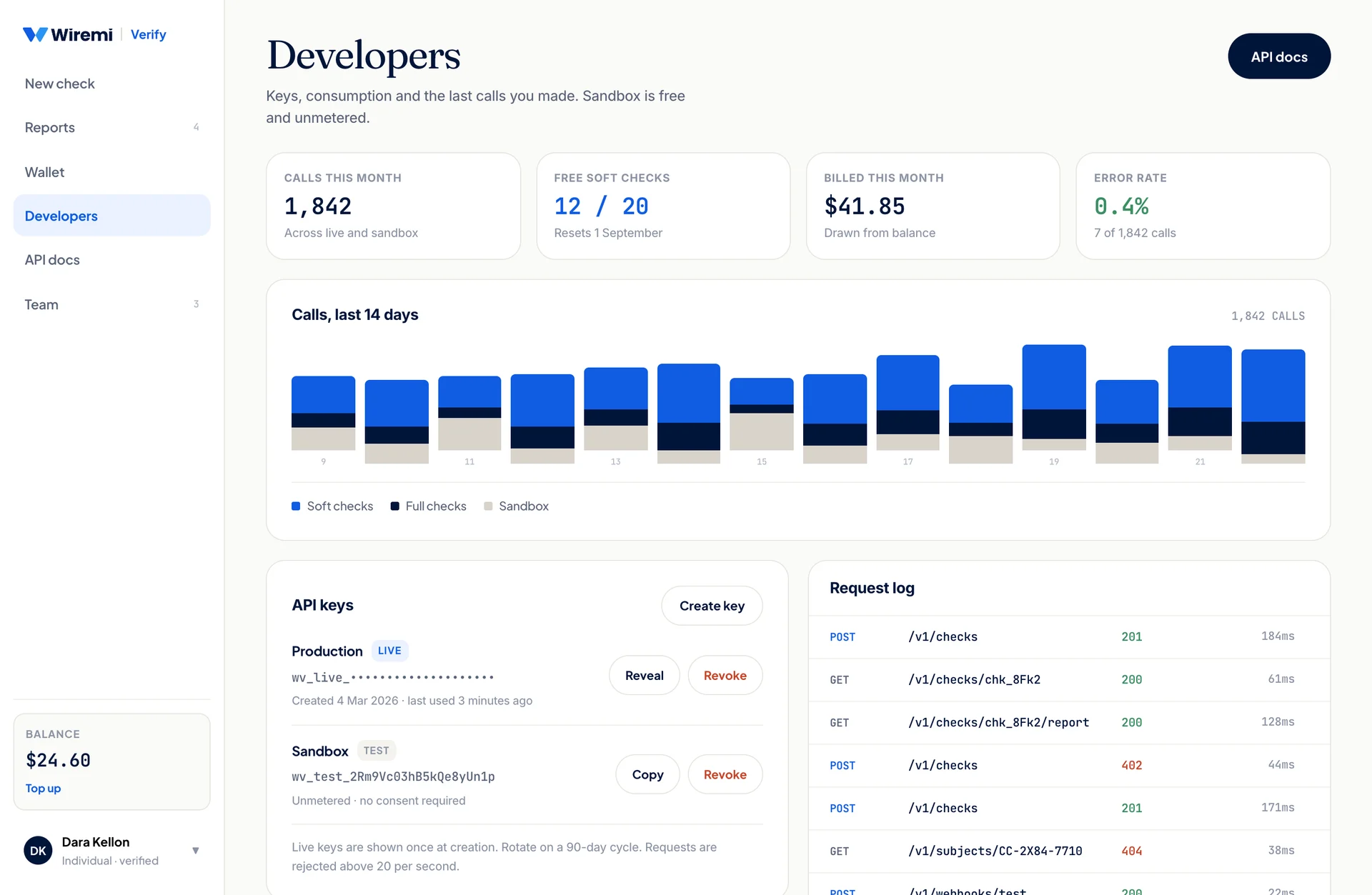
Unlimited, unmetered
Per live key
Old key overlaps the new one
Every request and every consent
Developer questions
- How long do I wait for consent?
- Up to fifteen minutes. After that the request expires and you get a check.expired event. Nothing is charged for an expired, declined or cancelled request.
- Can I poll instead of using the webhook?
- You can. GET /v1/checks/{id} returns the same status. The webhook is the intended path because it carries the signed scope, and the consent artefact is also available on its own endpoint.
- What is a permitted purpose?
- A declared reason, sent on every request and shown to the subject before they answer. Your account is enabled for the purposes you are lawfully allowed to check, and a request outside them returns purpose_not_permitted.
- Do sandbox checks need real consent?
- No. Sandbox returns fixture files on a timer so you can build the whole flow, including the declined and expired branches, before you go live.
- Is there an SDK?
- Node and Python today, both thin wrappers over the REST API. Anything else works with plain HTTPS and the samples on this page.
- Where is the data held?
- In Canada. Reports are served from Canadian infrastructure and the audit log is retained for seven years under Canadian law.
Wiremi Verify
Sandbox keys are free. Ask for them and start today.
Write to [email protected] with what you are building, and keys usually come back the same working day.